On-campus classes

Artificial Intelligence

Offered by Taabir Technical & Vocational Center, Karachi

Learn Python, Data Analysis, Machine Learning, Deep Learning, and Generative AI through practical, hands-on projects and real-world applications.

  • AI & Data Science
  • Urdu language
  • Minimum education: Matric / O-Level
  • 1 city

Where you’ll study

Taabir Technical & Vocational Center logo

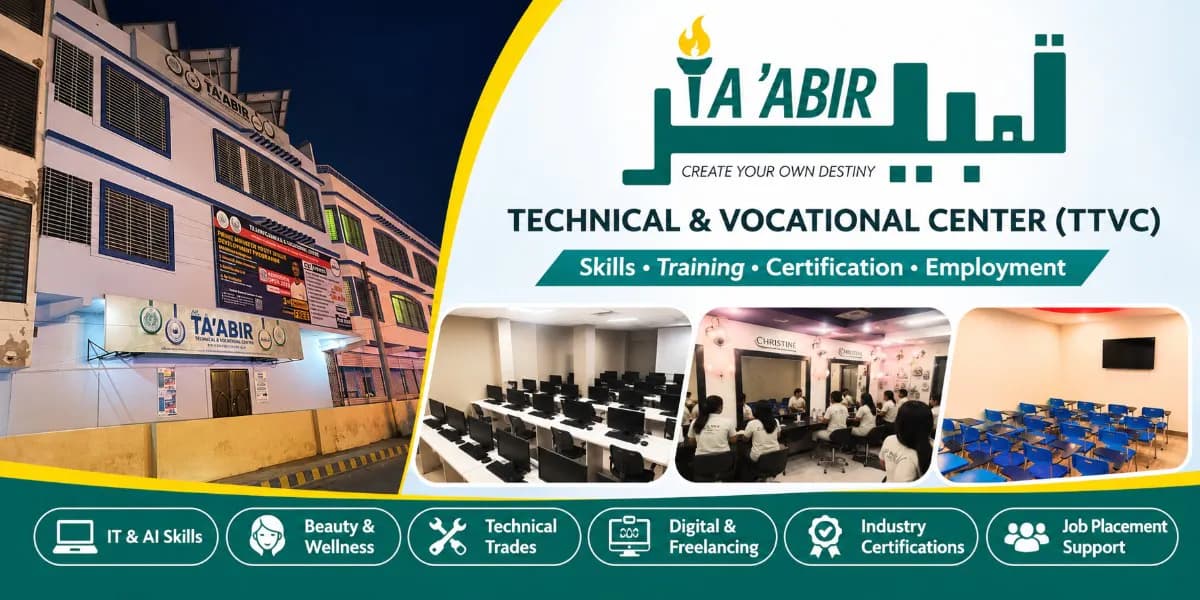
Taabir Technical & Vocational Center

NSDP affiliated campus

Taabir Technical and Vocational Center, 51\1, Gulshan e Jamee, Jinnah Avenue, Opposite Check Post No. 2, Malir, Karachi

View campus page

Campuses & batches

Karachi, Sindh

Taabir Technical & Vocational CenterNSDP verified campus

Private Institute

Taabir Technical & Vocational Center (TTVC) provides quality, industry-oriented technical and vocational training to empower youth with practical skills, enhance employability, and promote entrepreneurship.

New

6

Courses

75

Computers

3

Labs

Artificial Intelligence

Opening soon
Dates
1 Jan 2027 – 18 Jun 2027 · 6 months
Class days
Mon · Tue · Wed · Thu · Fri · 24 weeks
Venue
Computer Lab 1
Seats
20 of 20 left

Artificial Intelligence (AI) course provides practical training in Python programming, data analysis, machine learning, deep learning, and generative AI. Students will develop hands-on skills through real-world projects, including AI chatbots, prediction models, and image classification, preparing them for entry-level opportunities in AI and emerging technologies.

Weekly schedule (24 weeks)

Week 1: Introduction to Artificial Intelligence

  • • - Understand Artificial Intelligence and its importance in modern technology. — 1 Jan 2027, 11:00–13:00
  • • - Understand Artificial Intelligence and its importance in modern technology. — 4 Jan 2027, 11:00–13:00
  • • - Understand Artificial Intelligence and its importance in modern technology. — 5 Jan 2027, 11:00–13:00
  • • - Understand Artificial Intelligence and its importance in modern technology. — 6 Jan 2027, 11:00–13:00
  • • - Understand Artificial Intelligence and its importance in modern technology. — 7 Jan 2027, 11:00–13:00

Week 2: Python Programming Environment and Basics

  • • - Understand the role of Python in AI development. — 8 Jan 2027, 11:00–13:00
  • • - Understand the role of Python in AI development. — 11 Jan 2027, 11:00–13:00
  • • - Understand the role of Python in AI development. — 12 Jan 2027, 11:00–13:00
  • • - Understand the role of Python in AI development. — 13 Jan 2027, 11:00–13:00
  • • - Understand the role of Python in AI development. — 14 Jan 2027, 11:00–13:00

Week 3: Conditional Statements and Loops

  • • - Understand decision-making in Python. — 15 Jan 2027, 11:00–13:00
  • • - Understand decision-making in Python. — 18 Jan 2027, 11:00–13:00
  • • - Understand decision-making in Python. — 19 Jan 2027, 11:00–13:00
  • • - Understand decision-making in Python. — 20 Jan 2027, 11:00–13:00
  • • - Understand decision-making in Python. — 21 Jan 2027, 11:00–13:00

Week 4: Python Data Structures and Functions

  • • - Understand lists, tuples, sets, and dictionaries. — 22 Jan 2027, 11:00–13:00
  • • - Understand lists, tuples, sets, and dictionaries. — 25 Jan 2027, 11:00–13:00
  • • - Understand lists, tuples, sets, and dictionaries. — 26 Jan 2027, 11:00–13:00
  • • - Understand lists, tuples, sets, and dictionaries. — 27 Jan 2027, 11:00–13:00
  • • - Understand lists, tuples, sets, and dictionaries. — 28 Jan 2027, 11:00–13:00

Week 5: Introduction to Data Science and NumPy

  • • - Understand the role of data in Artificial Intelligence. — 29 Jan 2027, 11:00–13:00
  • • - Understand the role of data in Artificial Intelligence. — 1 Feb 2027, 11:00–13:00
  • • - Understand the role of data in Artificial Intelligence. — 2 Feb 2027, 11:00–13:00
  • • - Understand the role of data in Artificial Intelligence. — 3 Feb 2027, 11:00–13:00
  • • - Understand the role of data in Artificial Intelligence. — 4 Feb 2027, 11:00–13:00

Week 6: Data Handling with Pandas

  • • - Understand the purpose of the Pandas library. — 5 Feb 2027, 11:00–13:00
  • • - Understand the purpose of the Pandas library. — 8 Feb 2027, 11:00–13:00
  • • - Understand the purpose of the Pandas library. — 9 Feb 2027, 11:00–13:00
  • • - Understand the purpose of the Pandas library. — 10 Feb 2027, 11:00–13:00
  • • - Understand the purpose of the Pandas library. — 11 Feb 2027, 11:00–13:00

Week 7: Data Visualization with Matplotlib

  • • - Understand the importance of data visualization. — 12 Feb 2027, 11:00–13:00
  • • - Understand the importance of data visualization. — 15 Feb 2027, 11:00–13:00
  • • - Understand the importance of data visualization. — 16 Feb 2027, 11:00–13:00
  • • - Understand the importance of data visualization. — 17 Feb 2027, 11:00–13:00
  • • - Understand the importance of data visualization. — 18 Feb 2027, 11:00–13:00

Week 8: Data Cleaning and Exploratory Data Analysis

  • • - Understand the complete data analysis workflow. — 19 Feb 2027, 11:00–13:00
  • • - Understand the complete data analysis workflow. — 22 Feb 2027, 11:00–13:00
  • • - Understand the complete data analysis workflow. — 23 Feb 2027, 11:00–13:00
  • • - Understand the complete data analysis workflow. — 24 Feb 2027, 11:00–13:00
  • • - Understand the complete data analysis workflow. — 25 Feb 2027, 11:00–13:00

Week 9: Introduction to Machine Learning

  • • - Understand Machine Learning concepts and applications. — 26 Feb 2027, 11:00–13:00
  • • - Understand Machine Learning concepts and applications. — 1 Mar 2027, 11:00–13:00
  • • - Understand Machine Learning concepts and applications. — 2 Mar 2027, 11:00–13:00
  • • - Understand Machine Learning concepts and applications. — 3 Mar 2027, 11:00–13:00
  • • - Understand Machine Learning concepts and applications. — 4 Mar 2027, 11:00–13:00

Week 10: Regression Algorithms and Prediction Models

  • • - Understand regression and continuous-value prediction. — 5 Mar 2027, 11:00–13:00
  • • - Understand regression and continuous-value prediction. — 8 Mar 2027, 11:00–13:00
  • • - Understand regression and continuous-value prediction. — 9 Mar 2027, 11:00–13:00
  • • - Understand regression and continuous-value prediction. — 10 Mar 2027, 11:00–13:00
  • • - Understand regression and continuous-value prediction. — 11 Mar 2027, 11:00–13:00

Week 11: Classification Algorithms

  • • - Understand classification problems and applications. — 12 Mar 2027, 11:00–13:00
  • • - Understand classification problems and applications. — 15 Mar 2027, 11:00–13:00
  • • - Understand classification problems and applications. — 16 Mar 2027, 11:00–13:00
  • • - Understand classification problems and applications. — 17 Mar 2027, 11:00–13:00
  • • - Understand classification problems and applications. — 18 Mar 2027, 11:00–13:00

Week 12: Model Evaluation and Improvement

  • • - Understand underfitting and overfitting. — 19 Mar 2027, 11:00–13:00
  • • - Understand underfitting and overfitting. — 22 Mar 2027, 11:00–13:00
  • • - Understand underfitting and overfitting. — 23 Mar 2027, 11:00–13:00
  • • - Understand underfitting and overfitting. — 24 Mar 2027, 11:00–13:00
  • • - Understand underfitting and overfitting. — 25 Mar 2027, 11:00–13:00

Week 13: Unsupervised Learning and Clustering

  • • - Understand unsupervised learning techniques. — 26 Mar 2027, 11:00–13:00
  • • - Understand unsupervised learning techniques. — 29 Mar 2027, 11:00–13:00
  • • - Understand unsupervised learning techniques. — 30 Mar 2027, 11:00–13:00
  • • - Understand unsupervised learning techniques. — 31 Mar 2027, 11:00–13:00
  • • - Understand unsupervised learning techniques. — 1 Apr 2027, 11:00–13:00

Week 14: Introduction to Deep Learning and Neural Networks

  • • - Understand Deep Learning and its relationship with Machine Learning. — 2 Apr 2027, 11:00–13:00
  • • - Understand Deep Learning and its relationship with Machine Learning. — 5 Apr 2027, 11:00–13:00
  • • - Understand Deep Learning and its relationship with Machine Learning. — 6 Apr 2027, 11:00–13:00
  • • - Understand Deep Learning and its relationship with Machine Learning. — 7 Apr 2027, 11:00–13:00
  • • - Understand Deep Learning and its relationship with Machine Learning. — 8 Apr 2027, 11:00–13:00

Week 15: Computer Vision and Image Classification

  • • - Understand Computer Vision and image data. — 9 Apr 2027, 11:00–13:00
  • • - Understand Computer Vision and image data. — 12 Apr 2027, 11:00–13:00
  • • - Understand Computer Vision and image data. — 13 Apr 2027, 11:00–13:00
  • • - Understand Computer Vision and image data. — 14 Apr 2027, 11:00–13:00
  • • - Understand Computer Vision and image data. — 15 Apr 2027, 11:00–13:00

Week 16: Deep Learning Model Improvement

  • • - Review neural network training and evaluation. — 16 Apr 2027, 11:00–13:00
  • • - Review neural network training and evaluation. — 19 Apr 2027, 11:00–13:00
  • • - Review neural network training and evaluation. — 20 Apr 2027, 11:00–13:00
  • • - Review neural network training and evaluation. — 21 Apr 2027, 11:00–13:00
  • • - Review neural network training and evaluation. — 22 Apr 2027, 11:00–13:00

Week 17: Introduction to Natural Language Processing

  • • - Understand NLP and its real-world applications. — 23 Apr 2027, 11:00–13:00
  • • - Understand NLP and its real-world applications. — 26 Apr 2027, 11:00–13:00
  • • - Understand NLP and its real-world applications. — 27 Apr 2027, 11:00–13:00
  • • - Understand NLP and its real-world applications. — 28 Apr 2027, 11:00–13:00
  • • - Understand NLP and its real-world applications. — 29 Apr 2027, 11:00–13:00

Week 18: Generative AI and Large Language Models

  • • - Understand Generative AI and its capabilities. — 30 Apr 2027, 11:00–13:00
  • • - Understand Generative AI and its capabilities. — 3 May 2027, 11:00–13:00
  • • - Understand Generative AI and its capabilities. — 4 May 2027, 11:00–13:00
  • • - Understand Generative AI and its capabilities. — 5 May 2027, 11:00–13:00
  • • - Understand Generative AI and its capabilities. — 6 May 2027, 11:00–13:00

Week 19: Prompt Engineering and AI Productivity

  • • - Understand effective prompt design. — 7 May 2027, 11:00–13:00
  • • - Understand effective prompt design. — 10 May 2027, 11:00–13:00
  • • - Understand effective prompt design. — 11 May 2027, 11:00–13:00
  • • - Understand effective prompt design. — 12 May 2027, 11:00–13:00
  • • - Understand effective prompt design. — 13 May 2027, 11:00–13:00

Week 20: AI Chatbot Development and API Integration

  • • - Understand chatbot architecture and conversation flow. — 14 May 2027, 11:00–13:00
  • • - Understand chatbot architecture and conversation flow. — 17 May 2027, 11:00–13:00
  • • - Understand chatbot architecture and conversation flow. — 18 May 2027, 11:00–13:00
  • • - Understand chatbot architecture and conversation flow. — 19 May 2027, 11:00–13:00
  • • - Understand chatbot architecture and conversation flow. — 20 May 2027, 11:00–13:00

Week 21: AI Application Development and Deployment

  • • - Understand the AI application development lifecycle. — 21 May 2027, 11:00–13:00
  • • - Understand the AI application development lifecycle. — 24 May 2027, 11:00–13:00
  • • - Understand the AI application development lifecycle. — 25 May 2027, 11:00–13:00
  • • - Understand the AI application development lifecycle. — 26 May 2027, 11:00–13:00
  • • - Understand the AI application development lifecycle. — 27 May 2027, 11:00–13:00

Week 22: Final AI Project Planning and Development

  • • - Identify a practical problem suitable for an AI solution. — 28 May 2027, 11:00–13:00
  • • - Identify a practical problem suitable for an AI solution. — 31 May 2027, 11:00–13:00
  • • - Identify a practical problem suitable for an AI solution. — 1 Jun 2027, 11:00–13:00
  • • - Identify a practical problem suitable for an AI solution. — 2 Jun 2027, 11:00–13:00
  • • - Identify a practical problem suitable for an AI solution. — 3 Jun 2027, 11:00–13:00

Week 23: Final Project Implementation and Testing

  • • - Complete the core AI model or chatbot functionality. — 4 Jun 2027, 11:00–13:00
  • • - Complete the core AI model or chatbot functionality. — 7 Jun 2027, 11:00–13:00
  • • - Complete the core AI model or chatbot functionality. — 8 Jun 2027, 11:00–13:00
  • • - Complete the core AI model or chatbot functionality. — 9 Jun 2027, 11:00–13:00
  • • - Complete the core AI model or chatbot functionality. — 10 Jun 2027, 11:00–13:00

Week 24: Final Project Presentation and Career Preparation

  • • - Review important AI and Machine Learning concepts. — 11 Jun 2027, 11:00–13:00
  • • - Review important AI and Machine Learning concepts. — 14 Jun 2027, 11:00–13:00
  • • - Review important AI and Machine Learning concepts. — 15 Jun 2027, 11:00–13:00
  • • - Review important AI and Machine Learning concepts. — 16 Jun 2027, 11:00–13:00
  • • - Review important AI and Machine Learning concepts. — 17 Jun 2027, 11:00–13:00
Admissions open soon
University, college or academy? Become an NSDP campus. Earn every month.Now openWe allocate seats, send you students and fund every student you train.Apply now

What you’ll learn

  • Understand the fundamentals of Artificial Intelligence (AI) and its real-world applications.
  • Learn Python programming, including variables, data types, loops, functions, and object-oriented programming basics.
  • Work with Python libraries such as NumPy, Pandas, and Matplotlib.
  • Perform data collection, cleaning, processing, and analysis using Python.
  • Create charts, graphs, and visual reports to present data effectively.
  • Understand Machine Learning concepts, algorithms, and their practical applications.
  • Build predictive models using Linear Regression, Decision Trees, Classification, and K-Nearest Neighbors (KNN).
  • Understand Deep Learning, Artificial Neural Networks, and their basic architecture.
  • Explore Computer Vision and Image Classification techniques.
  • Learn Natural Language Processing (NLP) and text classification concepts
  • Understand Generative AI, ChatGPT, and Large Language Models (LLMs).
  • Develop effective prompts using Prompt Engineering techniques.
  • Explore AI APIs and develop basic AI-powered chatbots.
  • Build practical AI projects, including house price prediction and image classification applications.
  • Develop problem-solving, analytical thinking, and programming skills.
  • Complete and present a final AI-based project demonstrating practical knowledge and technical skills.

About this course

The Artificial Intelligence (AI) – Professional AI & Machine Learning Training Program at Ta'abir Technical & Vocational Center (TTVC) is a comprehensive 6-month training course designed to equip students with essential knowledge and practical skills in Artificial Intelligence, Python Programming, Data Analysis, Machine Learning, Deep Learning, and Generative AI. This beginner-friendly program introduces students to AI technologies through structured lessons, hands-on exercises, and real-world projects. Students will learn Python programming fundamentals, data handling using NumPy and Pandas, data visualization, machine learning algorithms, neural networks, natural language processing (NLP), and AI-powered applications. The course also covers modern Generative AI technologies, including ChatGPT, Large Language Models (LLMs), prompt engineering, AI APIs, and chatbot development. Throughout the training, students will complete practical assignments and projects such as data analysis applications, house price prediction models, image classifiers, text classifiers, and AI chatbots.

Requirements

  • Familiarity with computers, Windows operating systems, and internet browsing.
  • No prior programming or Artificial Intelligence (AI) experience required.
  • Access to a computer or laptop for practical exercises and assignments.
  • Basic English reading and comprehension skills to understand programming instructions and technical terminology.
  • Willingness to attend regular classes, complete weekly assignments, and participate in practical projects.
  • Enthusiasm for learning Artificial Intelligence, Python, Machine Learning, and emerging technologies.

Who this course is for

  • Individuals who want to develop practical Artificial Intelligence (AI) and programming skills.
  • Students with no previous experience in AI, Python, or Machine Learning.
  • Individuals interested in starting a career in Artificial Intelligence and emerging technologies.
  • Individuals interested in developing AI-related skills for online freelancing and digital services.
  • Employees who want to improve productivity through AI tools, automation, and data-driven solutions.
  • Individuals interested in using AI technologies to improve business operations and decision-making.

Your instructor

Zohaib Ali Dayo

Instructor - Artificial Intelligence

No reviews yet1 course on NSDP

Results-driven Data Scientist and Al Engineer specializing in Python, Machine Learning, and Generative AI. Proven expertise in engineering intelligent multistep Al pipelines, deploying predictive models, and extracting actionable analytics. Passionate about solving complex data challenges, optimizing ML algorithms for edge devices, and building intelligent autonomous agents that drive enterprise automation and advanced decision-making.

View full profile

Frequently asked questions

What is the duration of the Artificial Intelligence (AI) course?

The course duration is 6 months (24 weeks), covering theoretical concepts, practical training, weekly assignments, and real-world AI projects.

Do I need prior programming knowledge to join this course?

No. This course is designed for beginners. Students will learn Python programming from the basics before progressing to Artificial Intelligence and Machine Learning.

What topics will be covered during the course?

Students will learn Python Programming, Data Analysis, Machine Learning, Deep Learning, Natural Language Processing (NLP), Generative AI, ChatGPT, Prompt Engineering, and AI application development.

Will students receive practical training?

Yes. The course emphasizes hands-on learning through practical exercises, coding assignments, AI tools, and real-world projects.

Will students develop AI projects during the training?

Yes. Students will complete practical projects such as prediction models, data analysis applications, image classification, and basic AI chatbots.

What career opportunities are available after completing this course?

Students can pursue further training, internships, and suitable entry-level opportunities in Python Programming, Data Analysis, AI Application Development, and related technology fields.

Is this course suitable for students without an IT background?

Yes. Students from commerce, arts, science, and other educational backgrounds can join, provided they have basic computer knowledge and an interest in technology.

Will students receive assignments and assessments?

Yes. Students will complete weekly assignments, practical exercises, project-based assessments, and a final AI project to evaluate their learning progress.

24-hour refund policy

Try your first class with confidence.

  1. 1

    Attend your first class

    Join your first class at the campus and see if it suits you.

  2. 2

    Ask within 24 hours

    Not satisfied? Ask for a refund within 24 hours of the first class.

  3. 3

    Get your registration back

    Our team confirms your request and refunds your minor registration.

The same policy applies to self-paced courses (within 24 hours of your minor registration) and to live Zoom and on-campus classes (within 24 hours of the first class). Joined a live Zoom or on-campus class after its first class? Then the 24 hours count from your minor registration. To ask, press “Request a refund” on your course card in the NSDP student portal, or contact the NSDP helpline 0304-111-0985, WhatsApp 0320-8797409 or email support.department@nsdp.pk with your CNIC and PSID / challan number, or type “refund” in the NSDP Rehnuma chat. Requests after 24 hours aren’t eligible. See the cancellation & refund policy.

Want to compare campuses?See photos, facilities and reviews in the campus finder.

Student reviews

Loading reviews

Students also explore

Now on Google PlayDownload the NSDP Student app

Watch lessons, join live classes, take quizzes and get notified about new batches. Free on Google Play; the iPhone app is coming soon.

GET IT ONGoogle PlayComing soon on theApp Store
NSDP logo

© 2026 Naujawan Skills Development Program. All rights reserved.Recognised by the Office of the Speaker, Provincial Assembly of the Punjab · Inaugurated by the Governor of Punjab · For learners across Pakistan and overseas