In this article
Web development is one of the most requested digital skills. Businesses of every size need websites, and many need web applications too. The path below is the order most beginners find manageable.
Stage 1: HTML and CSS
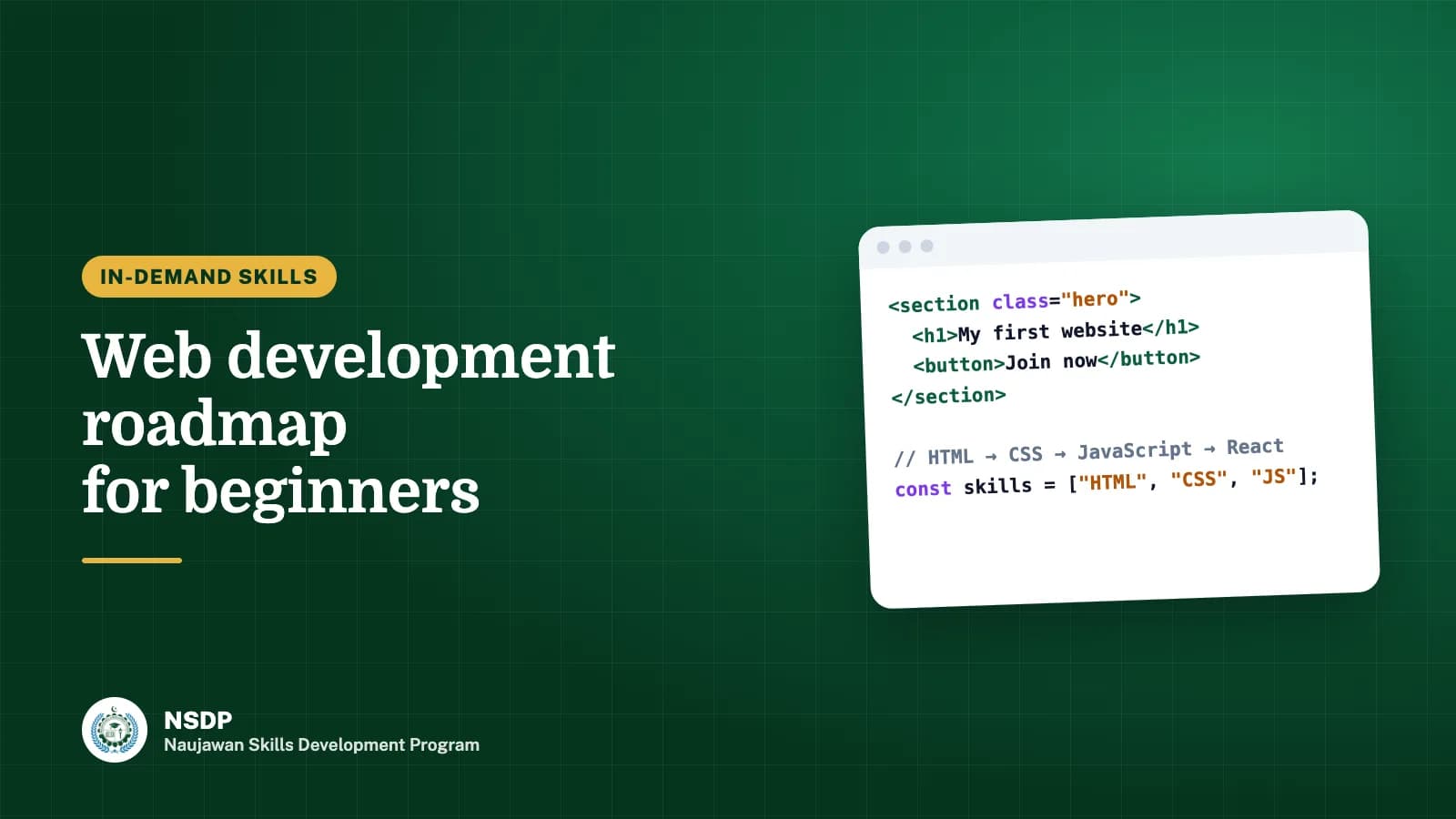
HTML gives a page its structure; CSS gives it its look. Learn headings, links, images, forms and layout with Flexbox and Grid. Make every page work on a phone as well as a laptop.
Practice: rebuild the home page of a local business you know.
Stage 2: JavaScript
JavaScript makes pages respond to the user. Learn variables, functions, arrays, objects, events and how to fetch data from an API.
Practice: a to-do list, a quiz and a weather page that reads live data.
Stage 3: Git and GitHub
Git records every change to your code. Employers and clients expect you to use it. Put each project on GitHub with a short description.
Stage 4: A front-end framework
Once JavaScript feels comfortable, learn one framework such as React. Learn components, state and routing.
Stage 5: The back end
Learn how a server stores and returns data: a language such as Node.js, Python or PHP, and a database. Build a small app with sign-in.
Stage 6: Real projects
Build two or three complete projects you can explain in an interview: what problem each solves, how you built it, and what you would improve.
How long does it take?
With regular study, most learners reach a job-ready beginner level in several months. Consistency matters more than speed: an hour every day beats a long session once a week.
NSDP offers web development as self-paced, live Zoom and on-campus courses. Each course page shows its monthly fee, length and the next batch.
Questions and answers
Do I need a powerful computer to learn web development?
No. A basic laptop with a modern browser and a code editor is enough for most of the roadmap. On-campus classes give you a lab computer if you do not have one.
Should I learn WordPress or coding first?
Learning HTML, CSS and JavaScript first helps you understand what WordPress does behind the scenes and fix problems when they appear.